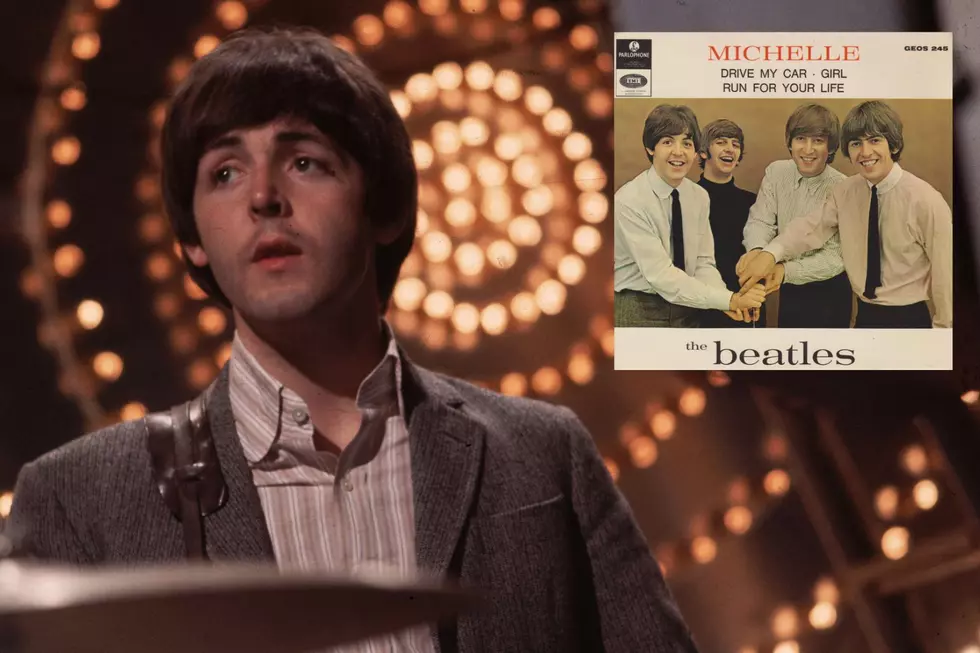
Is ‘Michelle’ From ‘Rubber Soul’ a Real Person?
"Michelle," the end of Rubber Soul's side one, is one of the Beatles' most-covered songs. But who is Michelle, if she is a real person at all?
The short answer is: no, she's not. But the story of how Paul McCartney landed on the name is an interesting one that actually traces back to the band's earliest days.
Where Did the Name Michelle Come From?
Before McCartney had any of the words, much less the title, he had nothing but an instrumental track he'd written years prior.
"'Michelle' was a tune that I'd written in Chet Atkins' finger-picking style," he said for Paul McCartney: Many Years From Now. "There is a song he did called 'Trambone' with a repetitive top line, and he played a bass line while playing a melody. This was an innovation for us; even though classical guitarists had played it, no rock 'n' roll guitarists had played it. The first person we knew to use finger-picking style was Chet Atkins ... I never learned it. But based on Atkins' "Trambone," I wanted to write something with a melody and a bass line in it, so I did. I just had it as an instrumental in C."
Listen to Chet Atkins' 'Trambone'
Atkins was part of the musical inspiration. The rest came from back when McCartney first started hanging out with John Lennon, who was nearly two years older and, as far as McCartney was concerned, much more worldly and artistic.
"So we'd tag along to these parties, and it was at the time of people like Juliette Greco, the French bohemian thing," McCartney explained in The Guardian in 2007. "They'd all wear black turtleneck sweaters, it's kind of where we got all that from, and we fancied Juliette like mad. Have you ever seen her? Dark hair, real chanteuse, really happening. So I used to pretend to be French, and I had this song that turned out later to be 'Michelle.' It was just an instrumental, but years later John said: 'You remember that thing you wrote about the French?' I said: 'Yeah.' He said: 'That wasn't a bad song, that. You should do that, y'know.'"
Listen to the Beatles' 'Michelle'
But it still needed words. So McCartney once again dipped back into the past and asked a woman named Jan Vaughan for some help. She was the wife of his old friend Ivan Vaughan, the man who first introduced McCartney and Lennon to one another in 1957, and, more importantly, a French teacher. He asked her for both a French name and some kind of French phrase that would rhyme with it, to which she provided: "Michelle, ma belle / Sont les mots qui vont tres bien ensemble."
"I said, 'All right, that would fit,'" McCartney later recalled. "And she told me a bit how to pronounce it, so that was it. I got that off Jan, and years later I sent her a cheque around. I thought I better had because she's virtually a co-writer on that. From there I just pieced together the verses."
John Lennon's Contribution to 'Michelle'
Then Lennon came into the picture to make the song complete.
"He and I were staying somewhere and he walked in and hummed the first few bars with the words, and he says, 'Where do I go from here?'" Lennon recalled to David Sheff in 1980. "I had been listening to Nina Simone – I think it was 'I Put a Spell on You.' There was a line in it that went: 'I love you, I love you.' That's what made me think of the middle eight for 'Michelle': 'I love you, I love you, I l-o-ove you.'
So...my contribution to Paul's songs was always to add a little bluesy edge to them. Otherwise, y'know, 'Michelle' is a straight ballad, right? He provided a lightness, and optimism, while I would always go for the sadness, the discords, the bluesy notes."
READ MORE: 25 Beatles Songs That Took the Longest to Finish
"Michelle" was released as a single in a handful of European countries, where it went to No. 1 in Belgium, France, Norway, the Netherlands, and more. McCartney doesn't play it often at his live shows, but when he does it's usually in France or Canada, where many French-speakers reside. He also famously performed the song at the White House in 2010, a special tribute to First Lady Michelle Obama.
In the end, what started as McCartney's silly fake French character — an effort to impress and attract girls at parties – became a historical success. In 1967, it won a Grammy for Song of the Year and in 1999, BMI named it the 42nd most performed song of the 20th century.
Watch Paul McCartney Perform 'Michelle' at the White House in 2010
How the Beatles' 'Rubber Soul' Influenced These 15 Artists
Gallery Credit: Allison Rapp

More From KKTX FM